


- Adjacent Excavations: Section 6 -

What Is A Party Wall?
The Party Wall etc. Act 1996 came into force on 1 July 1997 and applies throughout England and Wales.
The Act provides a framework for preventing or resolving disputes in relation to party walls, party structures, boundary walls and excavations near neighbouring buildings.
Anyone intending to carry out work in England and Wales of the type described in the Act must give Adjoining Owners notice of their intentions.
Where the intended work is to an existing party wall (Section 2 of the Act) a notice must be given even where the wall beyond the notional boundary line bisecting a party wall will not be directly worked on.
Under the Act, a wall is a party wall, even if a central boundary line bisects only part of its length.
The Act permits Adjoining Owners (neighbours) to agree to the Building Owner’s proposals, or reach agreement with the Building Owner on changes to working practices, working hours and access.
The picture below illustrates structures as defined in the Act, displayed in a typical semi-detached setting.

Is My Work Covered By The Act?
To help understand how and when the Act might affect you, try thinking of yourself as a joint owner of the party wall, rather than the sole owner of half of it.
The official language of the Act defines an Adjacent Owner in a number of legal ways.
In this context, we can use the terms ‘Adjacent Owner’ and ‘neighbour’ interchangeably, neighbour being the more familiar.
The legal distinction only matters once notices are required, which must be served to the Adjacent Owner as defined by the Act.
Giving notice or serving a Notice is required for all work covered by the Act and different time scales are involved.
Lets look at the three main Sections of the Act that outline which types of work are covered, and will therefore require you to serve notice.


ONE. Work on Existing Party Walls: Section 2 of the Act
Any work carried out directly to an existing party wall or party structure will be covered by the Act.
Common examples include cutting into a wall to insert a steel, removing a chimney breast, inserting a damp proof course or extending a wall down to form a basement.
Certain types of construction are almost inevitably covered by the Act, such as loft conversions, dormers and extensions.
Notice must be given of all work carried out directly to a Party Wall structure. Notice(s) must be served at least two months before starting work, and are valid for one year.
Timing a Notice can be tricky in the wider context of works planning, and they must follow a strict format or risk being invalid, which is why we strongly recommend taking expert advice from Peerless.
TWO. Excavation Near Neighbouring Buildings: Section 6 of the Act
The Act applies if you excavate, or excavate and construct foundations for a new structure within 3 metres of any part of a neighbour’s structure, where those foundations will be deeper than the neighbours, or…
…within 6 metres of any part of a neighbour’s structure, where any part of that work will meet a line drawn downwards at 45° in the direction of the excavation from the bottom of the neighbour’s foundations.
In either case, you must serve notice. The Notice must be served at least one month before starting work and is valid for one year.
Foundation Notices are arguably the most complicated, and must include plans sections and statements of intent etc.
For that reason we strongly recommend taking expert advice from Peerless.


THREE: New Building on The Boundary Line or Line of Junction : Section 1 of the Act
If you plan to build a party wall or party fence wall astride the boundary line or wholly on your own land but up against the boundary line, you will need to serve notice.
The term ‘the line of junction’ is used in these types of notice, rather than 'boundary line' although both refer to the notional line that bisects a party wall or structure.
Typical works requiring a notice include building a new flank wall for a side return, building a new party fence wall astride the junction and reinstating a structurally unsound wall.
In practice, the format and content of a Line of Junction Notice, as well as the content of any subsequent Agreement can be complicated.
An Agreement should detail allocation of construction costs, the location of the new structure, etc.
This type of work typically requires more than one Notice, as the proposed structure will require new or possibly altered foundations, and we recommend taking expert advice.
Contact Us
If you are still in any doubt about whether the Party Wall Act will apply to the work you are planning, simply call us on: 07892 839667 or Contact Us for a free appraisal of your needs.
The Party Wall etc. Act 1996
The Party Wall etc. Act 1996 came into force on 1 July 1997 and applies throughout England and Wales.
The Act provides a framework for preventing or resolving disputes in relation to party walls, party structures, boundary walls and excavations near neighbouring buildings.
Anyone intending to carry out work in England and Wales of the type described in the Act must give Adjoining Owners notice of their intentions.
Where the intended work is to an existing party wall (Section 2 of the Act) a notice must be given even where the wall beyond the notional boundary line bisecting a party wall will not be directly worked on.
Under the Act, a wall is a party wall, even if a central boundary line bisects only part of its length.
The Act permits Adjoining Owners (neighbours) to agree with the Building Owner’s proposals or reach agreement with the Building Owner on changes to working practices, working hours and access.
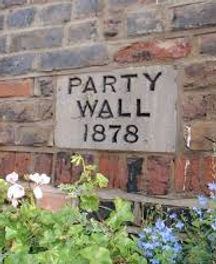

Under the Act
If a dispute arises in relation to a new party wall or party fence wall under Section 1 or…
…there is no written consent by the Adjoining Owner within fourteen days to a notice served in relation to an existing structure under section 2 or an excavation under Section 6, then…
…the Act provides for the matter to be resolved by a surveyor or surveyors in a procedure for the resolution of disputes under Section 10.
Slightly dry, and this is just the lightest summary of the Act. The most important thing to know about the Act is how and when it affects you. Hopefully you understand a little more having read this page.


Contact Us